

The 3-Pillars
Initiative.
Breaking the affordable housing logjam in sub-Saharan Africa.
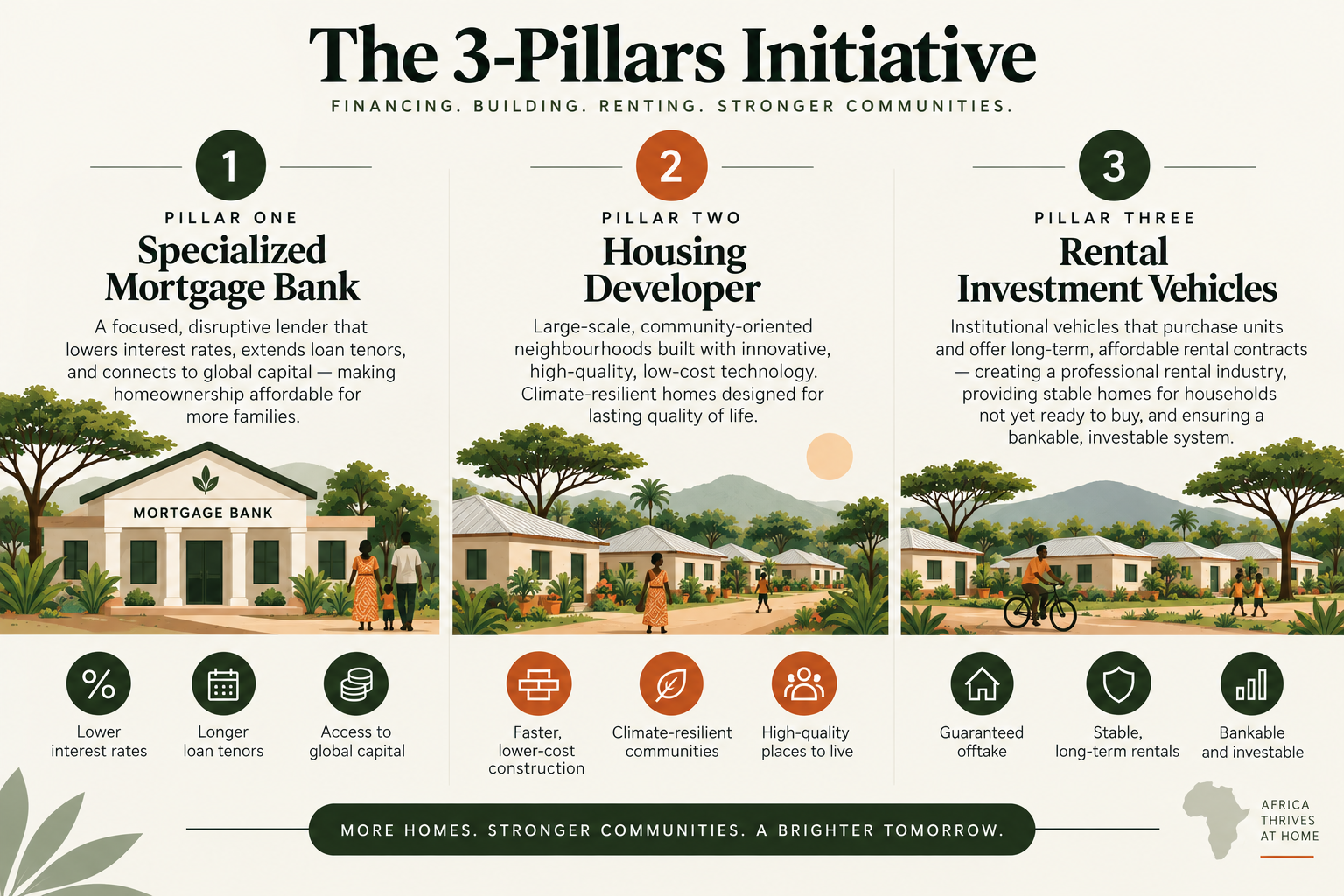
One integrated company. Three coordinated pillars. Real scale.
Three roadblocks.
One integrated answer.
Finance needs supply. Supply needs finance and assured offtake. Rental stabilises the ecosystem. When all three operate under one coordinated plan, the system becomes self-reinforcing and scalable.
—— WE’VE GOT ANSWERS
A system designed
to be unstoppable.
Six structural advantages distinguish the 3-Pillars Initiative from every prior attempt to solve affordable housing in sub-Saharan Africa at scale.
01 — Systemic Design
Three problems solved at once
Previous attempts failed because they treated finance, supply, and tenure as separate problems. The 3-Pillars Initiative engineers all three into a single, coordinated system.
02 — Capital Efficiency
Bankable at every layer
The Mortgage Bank is a regulated lender. The Developer produces a tangible, financeable asset. The REIVs are institutional vehicles with long-term contracted income.
03 — Market Timing
The window is now
Africa's urbanisation inflection is already underway. The cohort entering the housing market over the next decade is unlike anything the region has seen.
04 — Operational Depth
Built by practitioners
The GHS team brings decades of direct housing finance, development, and policy experience in sub-Saharan markets. We are the operator, not a fund seeking one.
05 — Self-Reinforcing
The flywheel effect
As the Mortgage Bank grows its book, it de-risks the developer. As unit costs fall, mortgages become more affordable. As REIVs grow, occupancy is guaranteed.
06— Impact Credentials
Returns with clear social metrics
Every unit delivered is a measurable outcome. GHS tracks households housed, mortgage default rates, rental stability, and neighbourhood health indices.
—— TECHNOLOGY THAT ENABLES SCALE
Built for volume.
Engineered to last.
We use factory-produced precast systems (Betoniq methodology) to deliver higher-quality homes at lower cost and at a speed traditional construction cannot match.
Precast & Prefabricated Systems
Factory-produced structural components manufactured under quality-controlled conditions and assembled rapidly on site.
Betoniq method • Off-Site manufacturing
Speed & Cost Advantage
Construction time dramatically reduced versus traditional masonry. Lower labour dependency translates directly to lower unit costs.
Faster build • Cost reduction
Climate Resilience
Green structures engineered for local climate — thermal performance, wind resistance, and drainage ensuring durability over a 120+ year asset life.
Thermal performance • 120+ year asset life
Scalable Production
The factory model scales to match project pipelines. The same system serves a 200-unit estate and a 10,000-unit city-wide programme.
Volume output • Pipeline ready
Digital Project Management
BIM-driven tools track every unit from factory to occupancy — enabling transparent reporting for investors and lenders.
BIM • Investor reporting
Local Value Chain
Factory methodology sources local materials and develops local technical skills — building human capital in each market.
Local materials • Skills development
"Housing production at scale that is bankable, livable, and sustainable — with major affordability gains across the entire supply chain."
— 3-Pillars Initiative Programme Thesis

—— PARTNER WITH US
Join the coalition
building at scale.
We are seeking strategic partners across the capital structure — DFIs, impact investors, commercial lenders, development partners, and technology providers aligned with scalable, bankable affordable housing in sub-Saharan Africa.
Capital Partners
DFIs, impact funds, institutional lenders, and blended finance vehicles.Development Partners
Bilateral and multilateral agencies, government bodies, and city authorities.Technology Partners
Precast manufacturers, construction technology firms, and digital platform providers.
Request Materials
Receive our full investor deck, financial model summary, and programme overview.